No Place
Daniel Cabrillos Jacobsen, iris yirei hu, Marigold Santos, Raya Simpao
Silverlens, New York
About

Ancient mariners connected the stars, rendering them into shapes and figures that told otherworldly stories of deities and mythological creatures. These celestial patterns helped them navigate the seas and, by extension, locate themselves within the vastness of the universe. Similarly, the painters in this exhibition map stories—whether quotidian or supernatural—onto canvas or linen, guided by diasporic gazes that look both inward and beyond the world around them.
No Place brings together four early- to mid-career painters from different points within the constellation of the Southeast Asian diaspora. Through painting, these artists explore what resides in their hearts: memories of elsewhere, experiences of inbetweenness, portals to other realms, and observations of everyday life. Rather than framing “no place” as a condition of unbelonging, the exhibition proposes it as a generative space of connection. Through their diasporic perspectives, the artists cultivate relationships with the cosmos, with disparate geographies, with others, and with themselves. In doing so, they suggest that belonging can emerge not from fixed coordinates, but through the ongoing act of looking, remembering, learning, and painting.
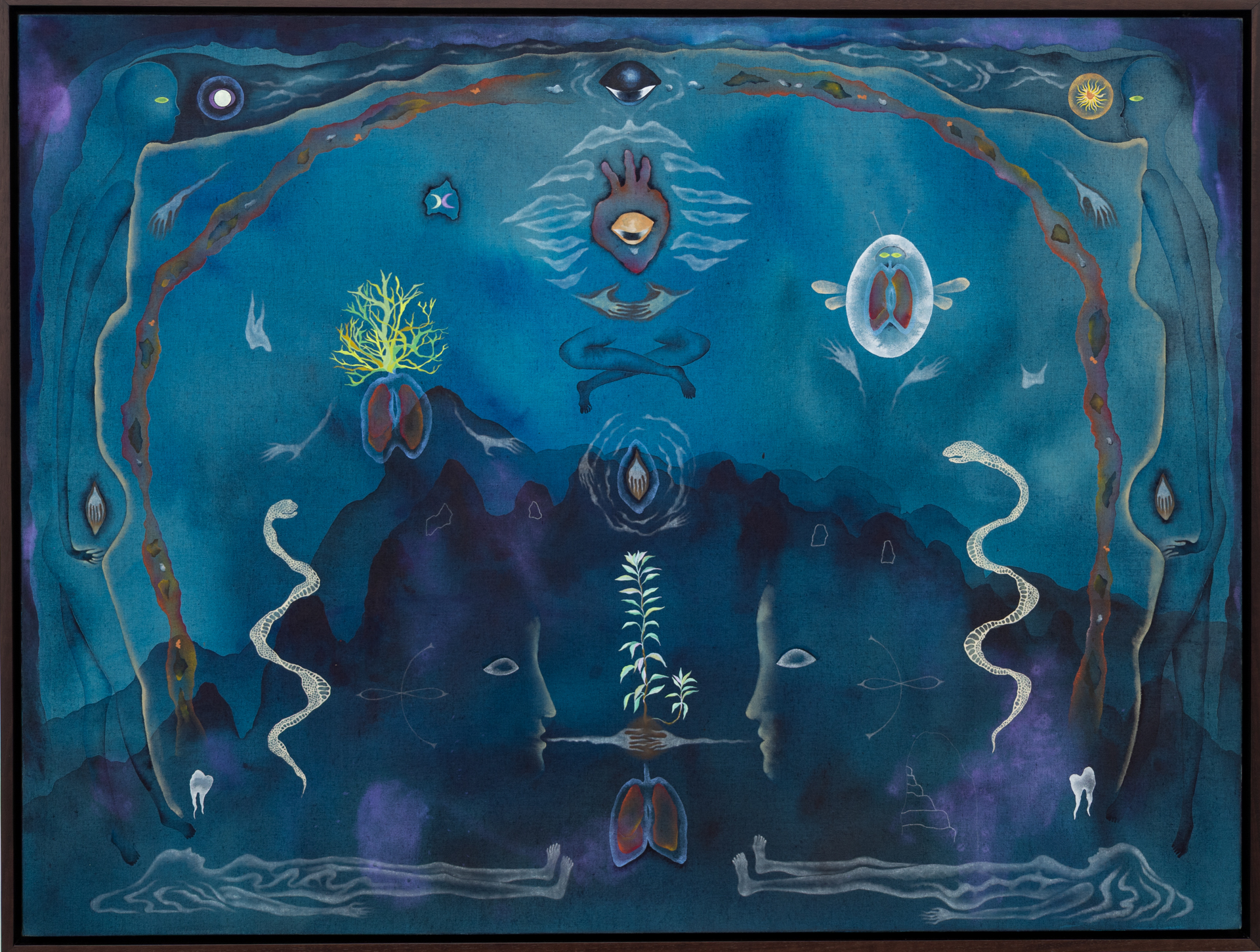
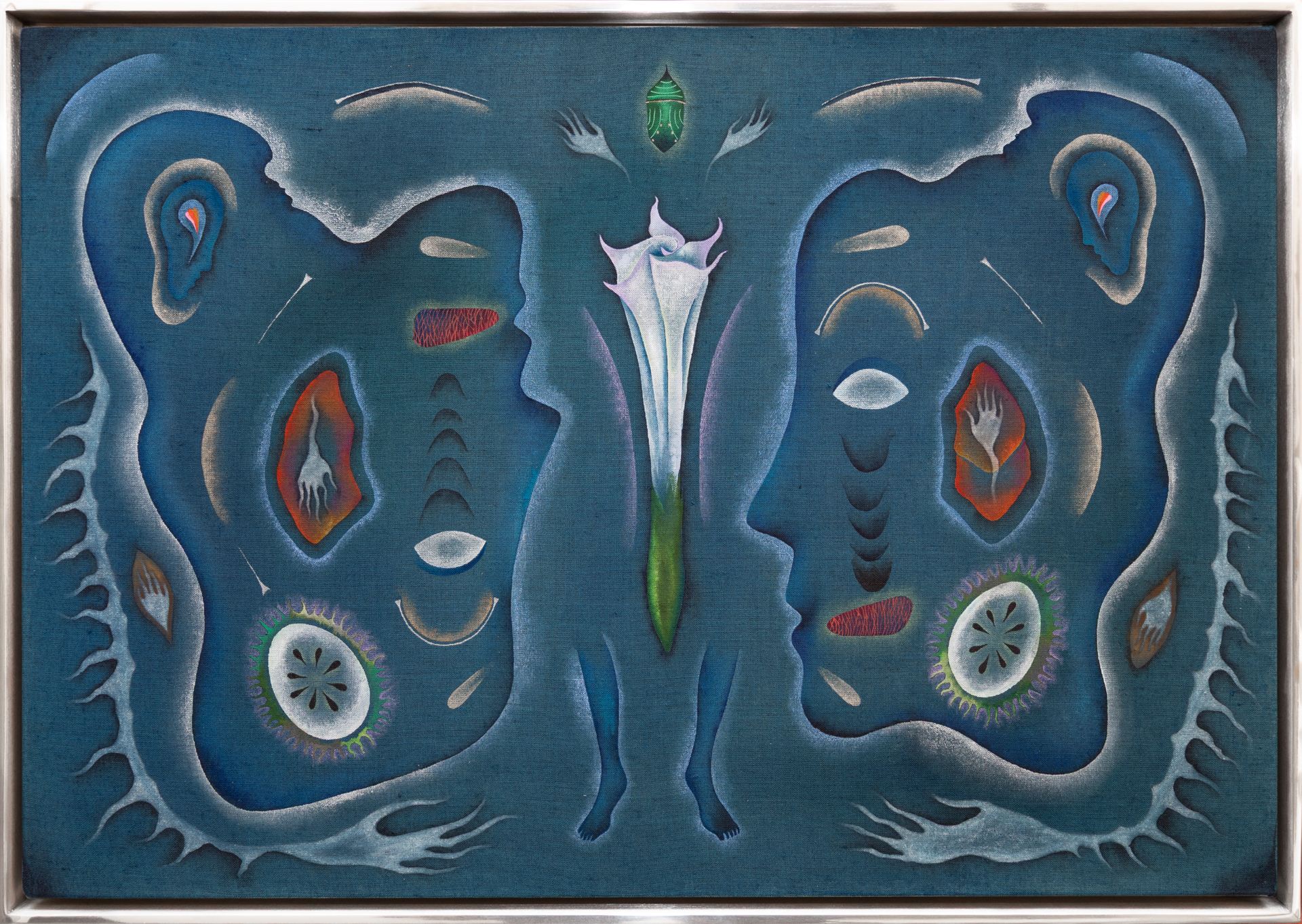
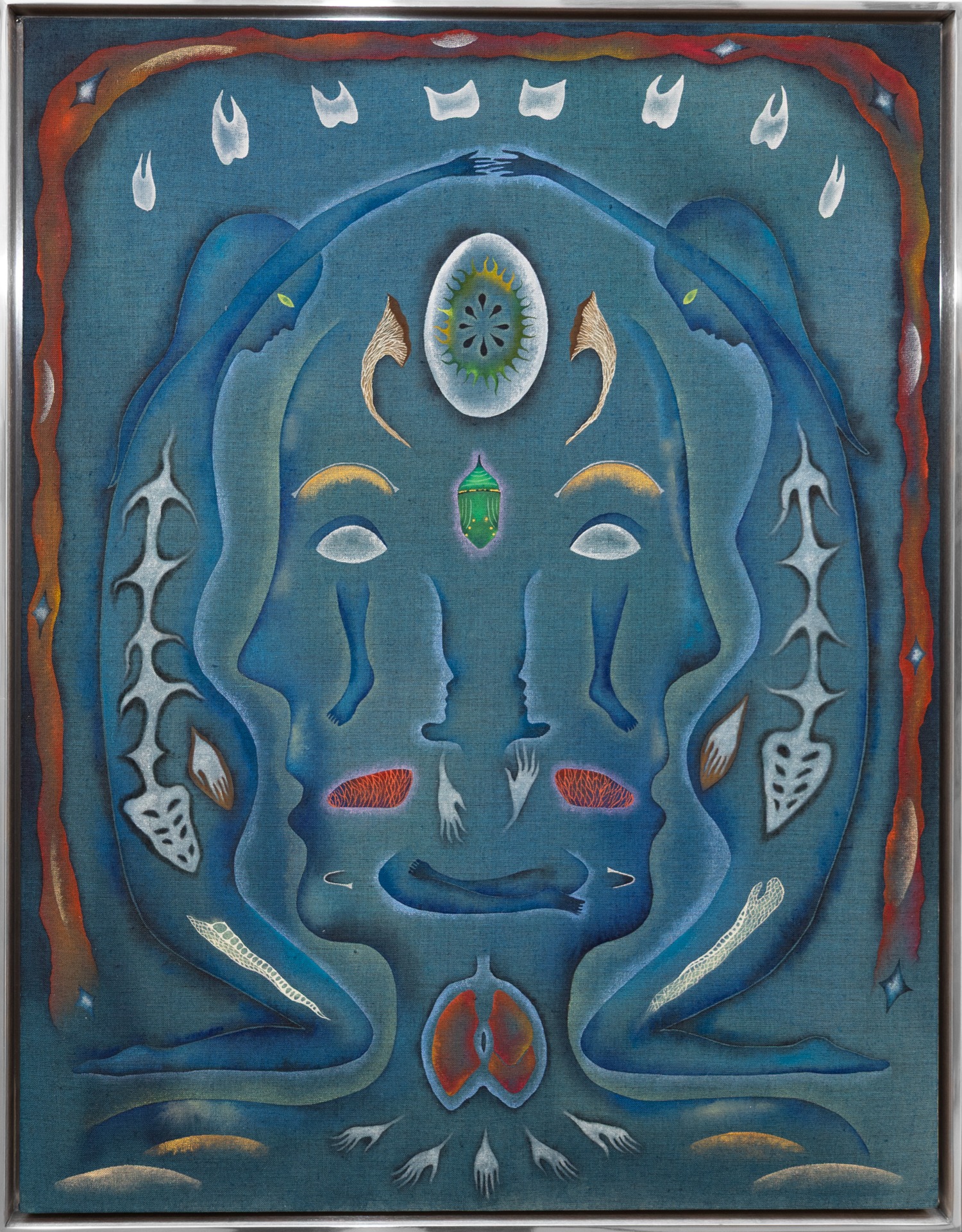
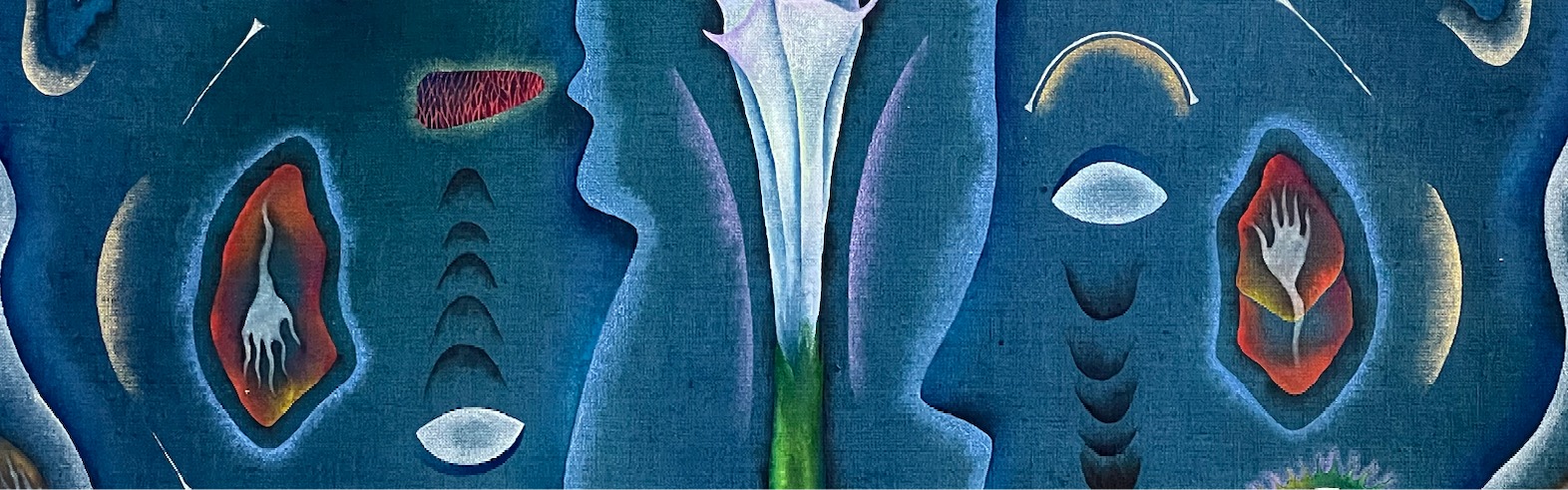
American writer Rebecca Solnit describes blue as “the color of there seen from here, the color of where you are not.” Like gazing into a vast blue sky, the looker can only see and yearn from afar, or in the words of Solnit, blue is “the color of longing for the distances you never arrive in, for the blue world”. Los Angeles–based artist iris yirei hu gives form to this understanding of blue as a space of utopic desire for unity and transformation through their mixed media works on linen.
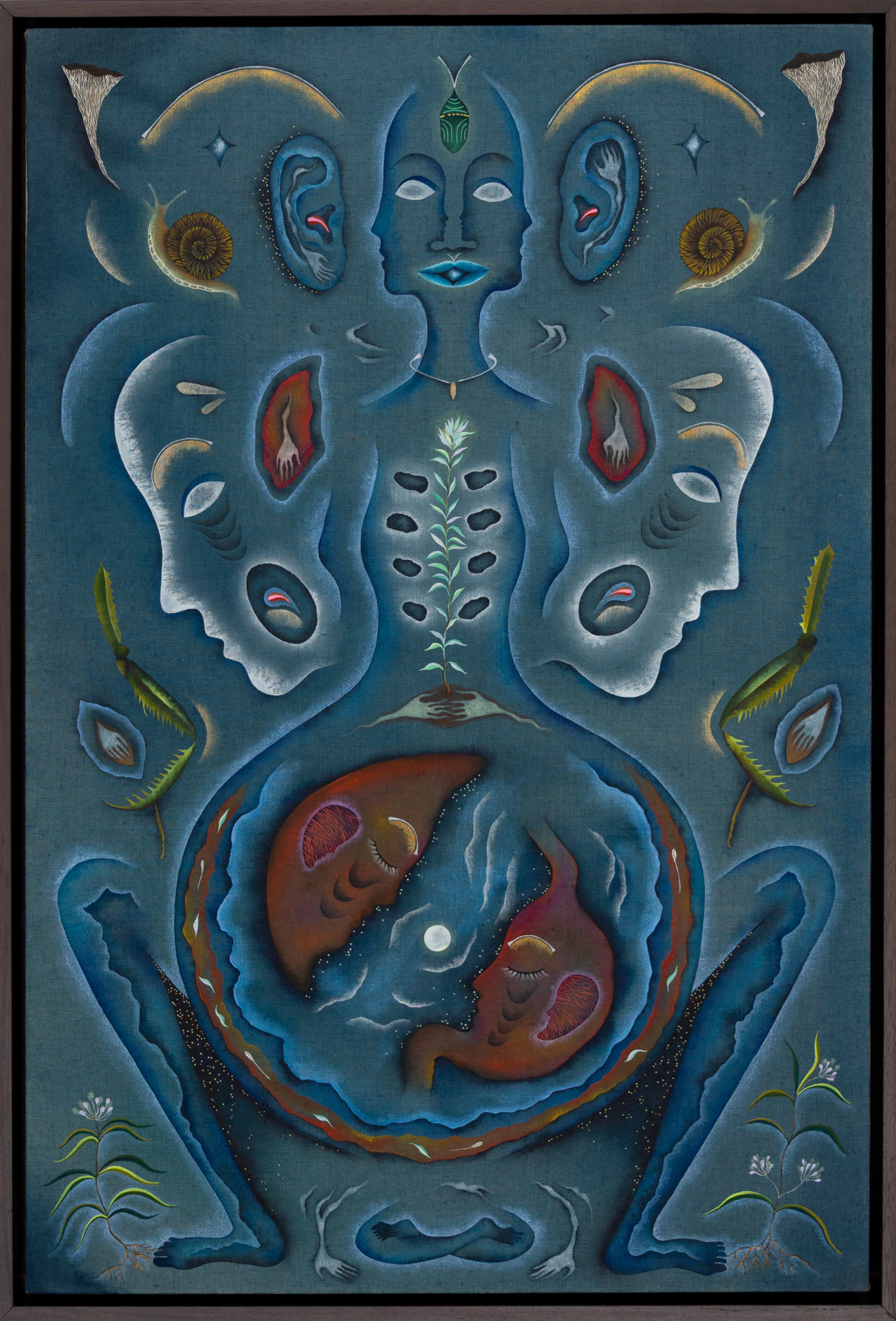
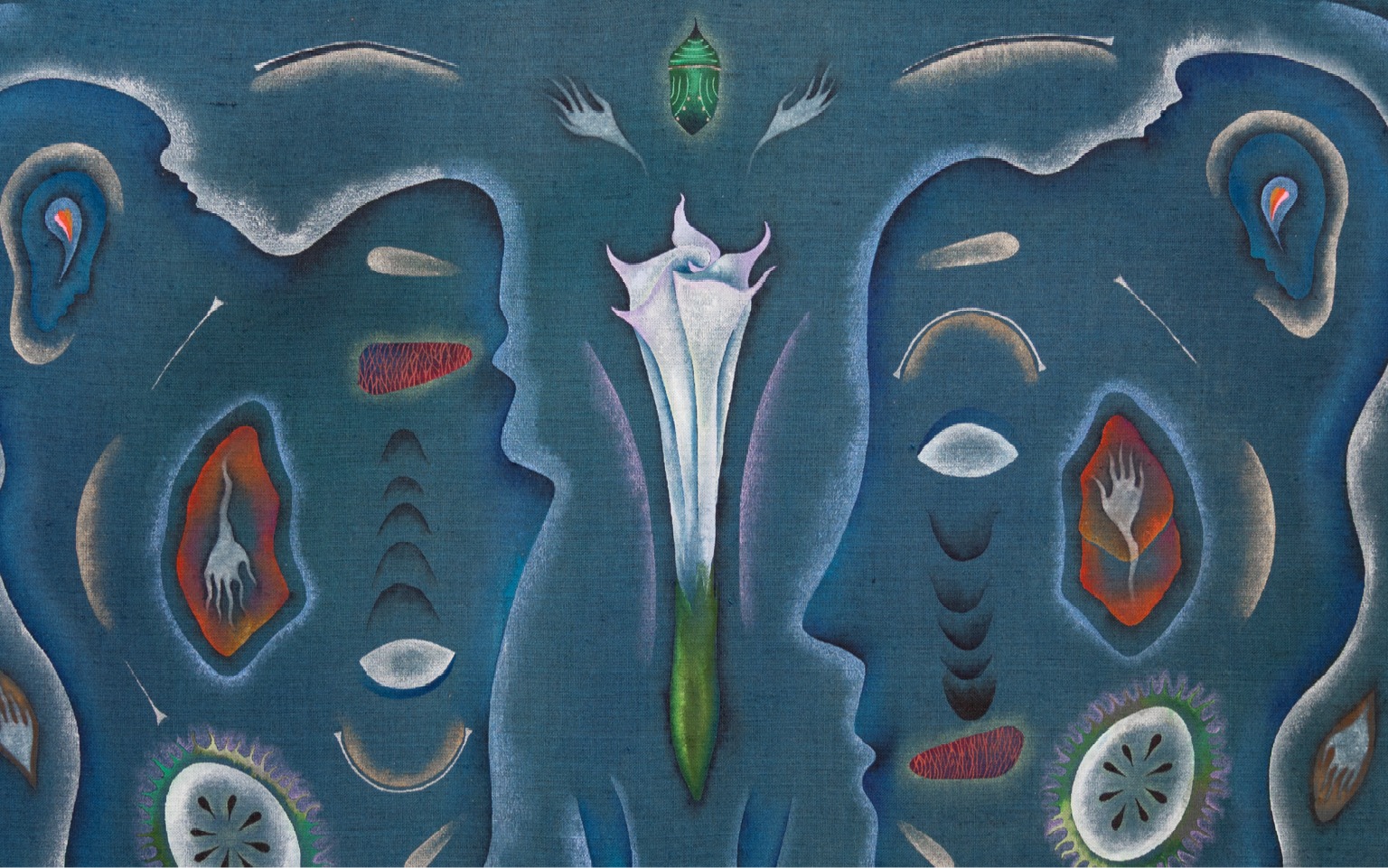
Hu’s paintings are talismanic and evocative of reality beyond the material. Recurring motifs, such as disembodied teeth, symbolic flora and fauna, and dreamlike figures, inhabit a liminal realm between memory, mythology, and personal narrative. Central to this body of work is The Blue Child, hu’s allegorical persona, a figure through which belonging and spiritual becoming unfold. Rather than a fixed character, The Blue Child remains in a continual state of transformation. In The word of world is seedkeeper (2026), hu depicts a universe of balanced relationality among ecosystem, the cosmos, and humans. Boundaries among them are porous and the symmetry along the central vertical axis conveys harmony.
Reminiscent of Filipino American Bay Area artist Carlos Villa whose work is infused with mysticism, but who was engaged in art actions that sought justice, hu reflects on the unseen forces that connect inner and outer worlds. In Soothsayers (2024), blue bleeds into the natural fibres of the linen at various intensities, creating a skyscape upon which symbols of birth (pregnant figures, saplings) and rebirth (molted snakeskin) conjure prophetic visions of a world that could be. Hu is as much committed the places of interconnectedness that have yet to be realized as she is to the land upon which she works, the kinships she fosters, and nurturing good relations with both. Hu’s blue world is a horizon of possibility: a place that can be sensed, desired, and imagined, even if it cannot be fully reached in the here and now.
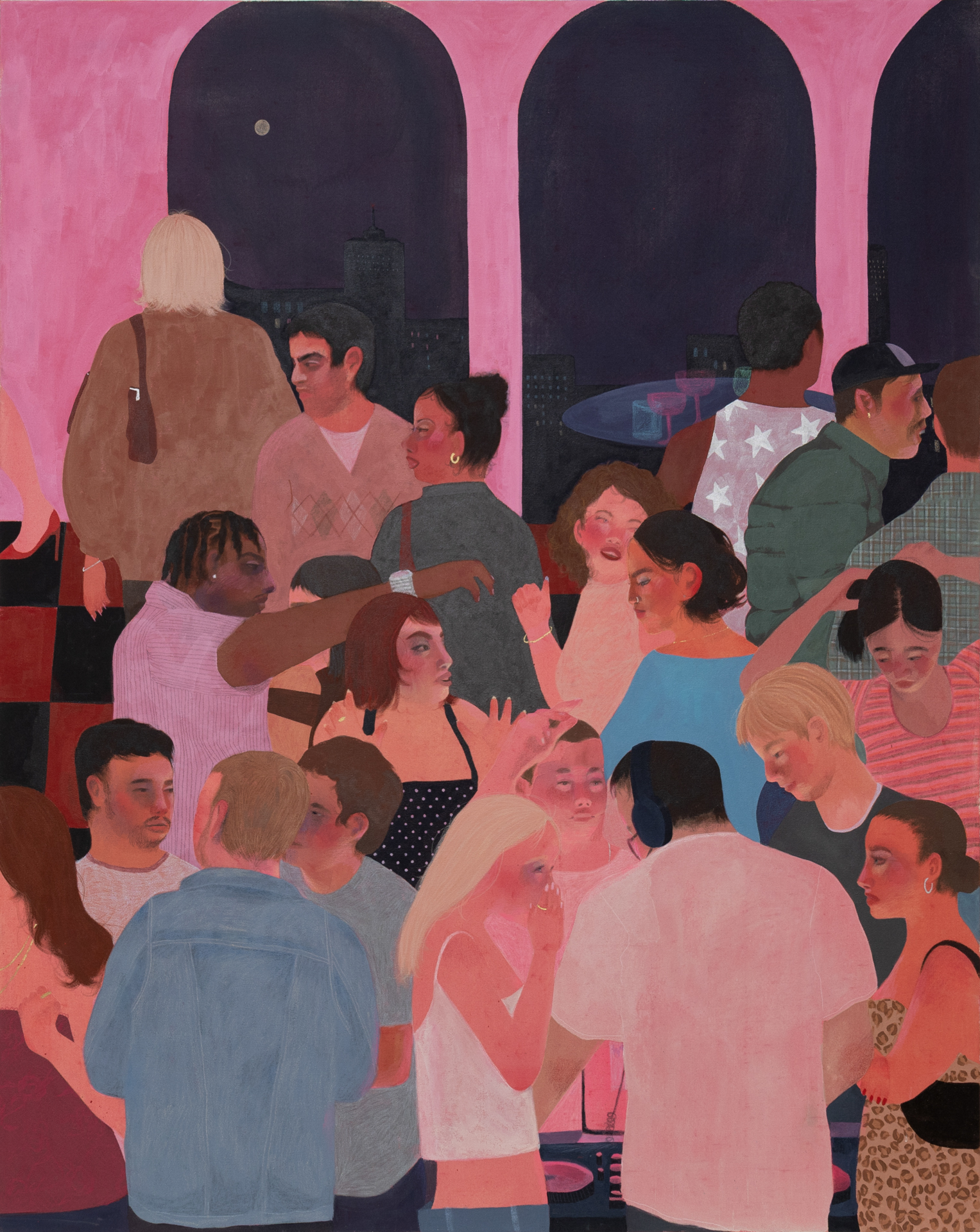
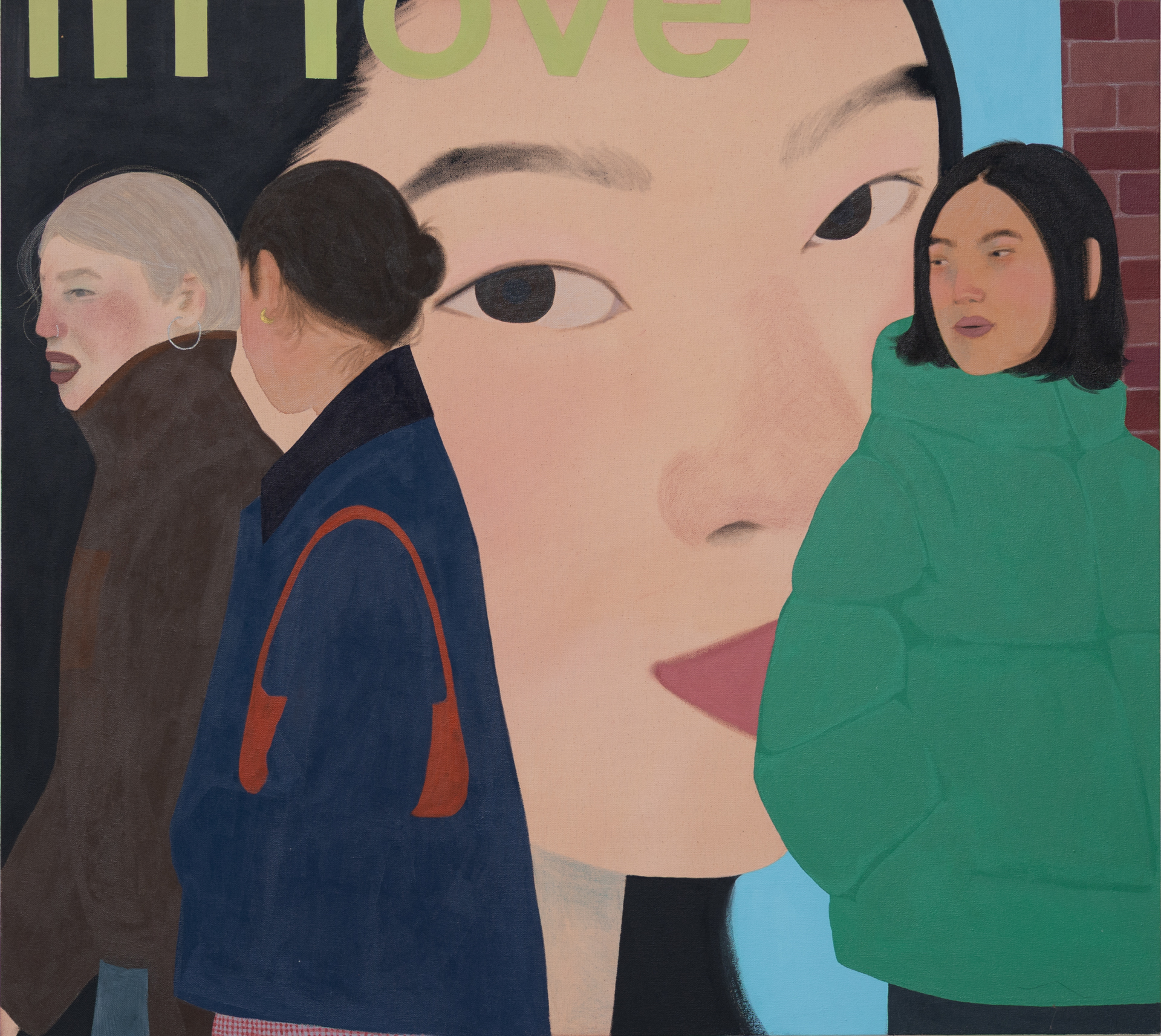
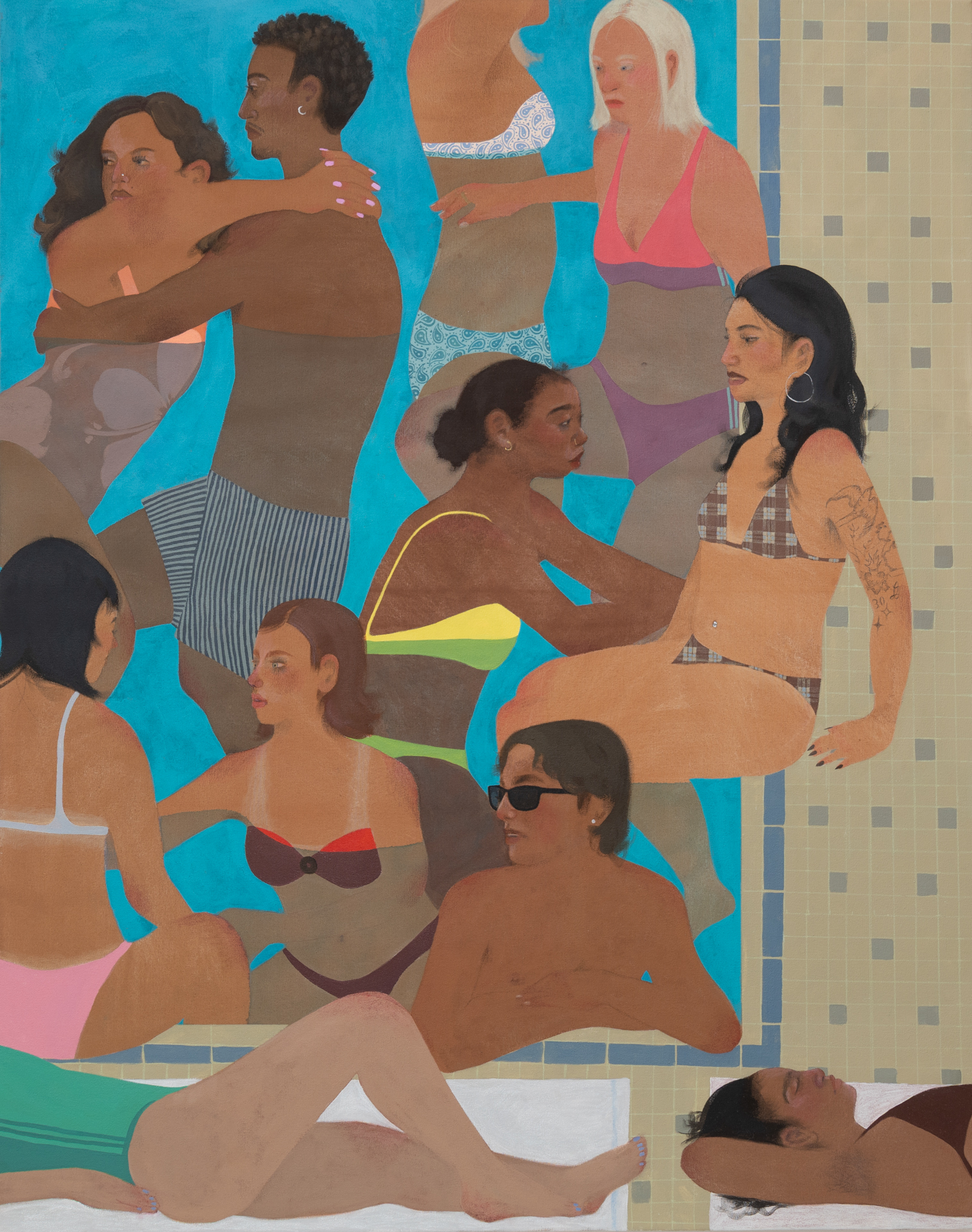
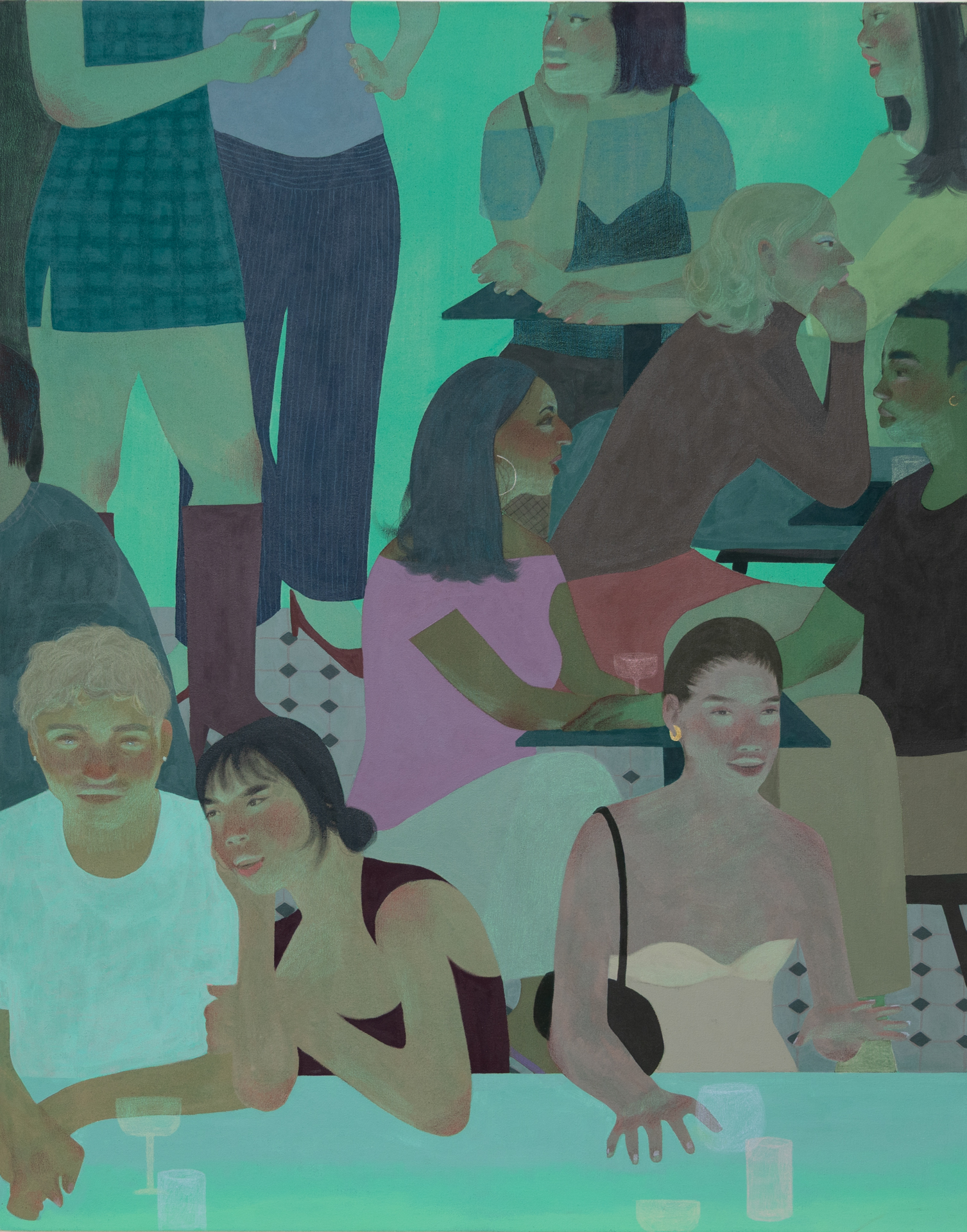
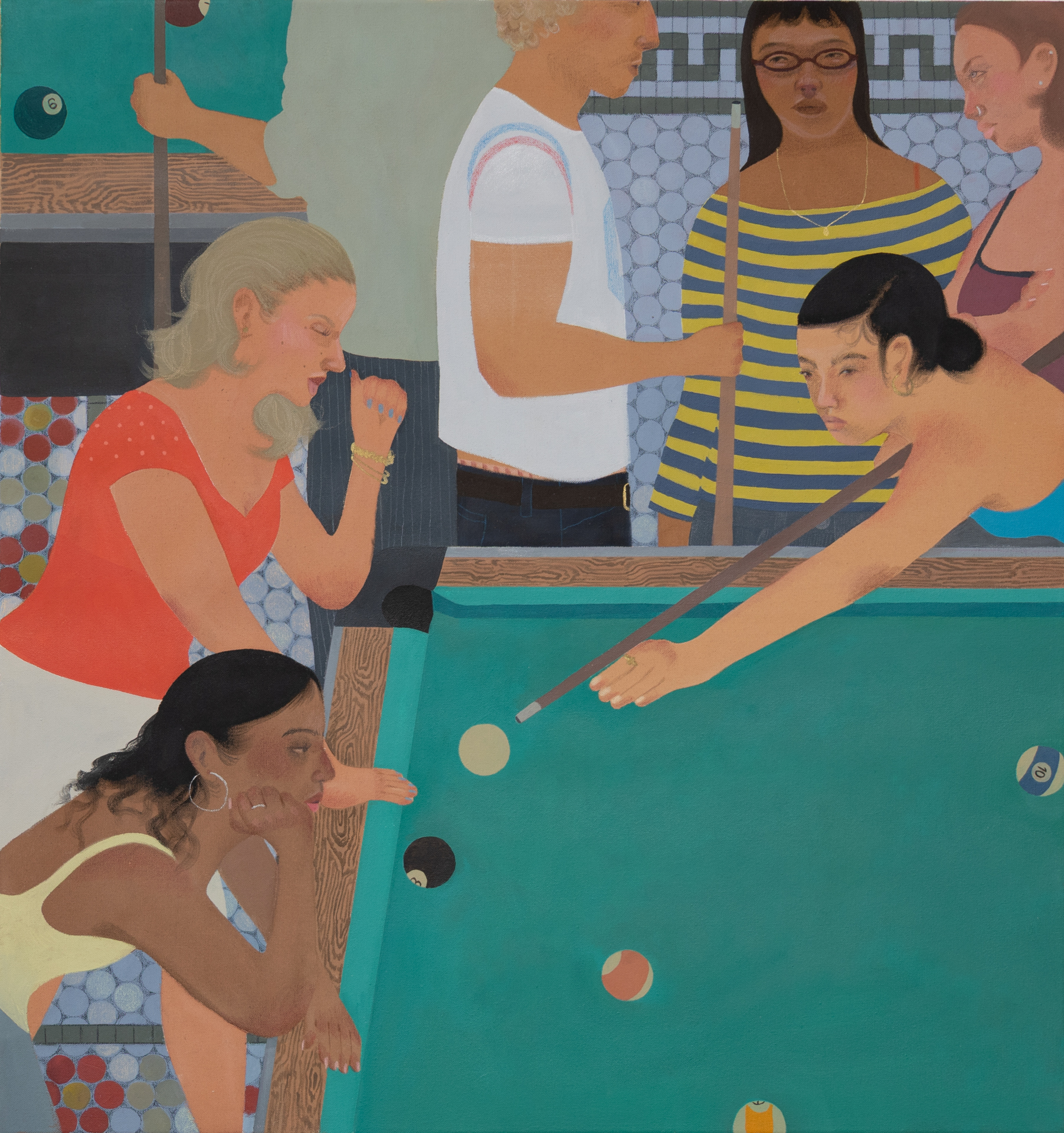
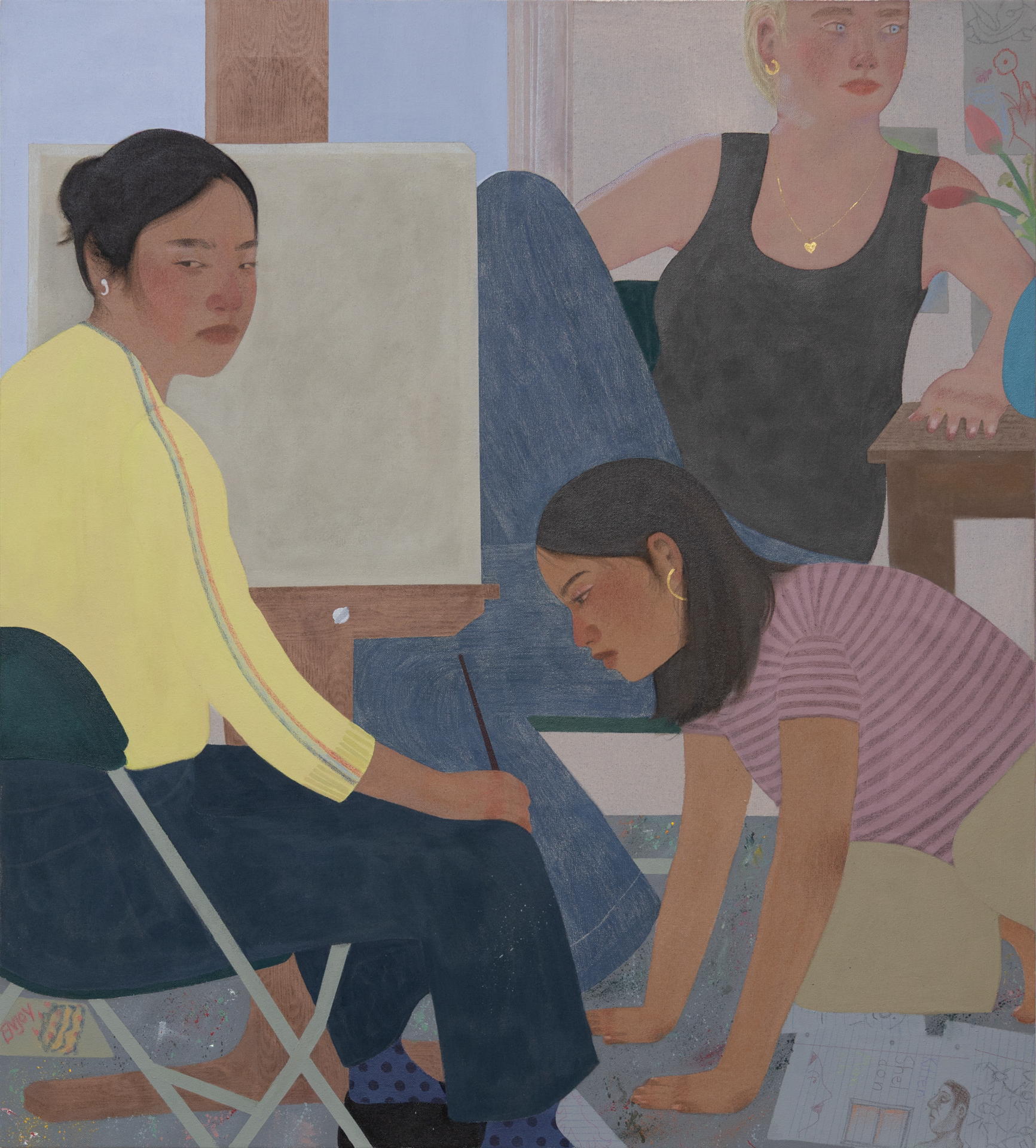
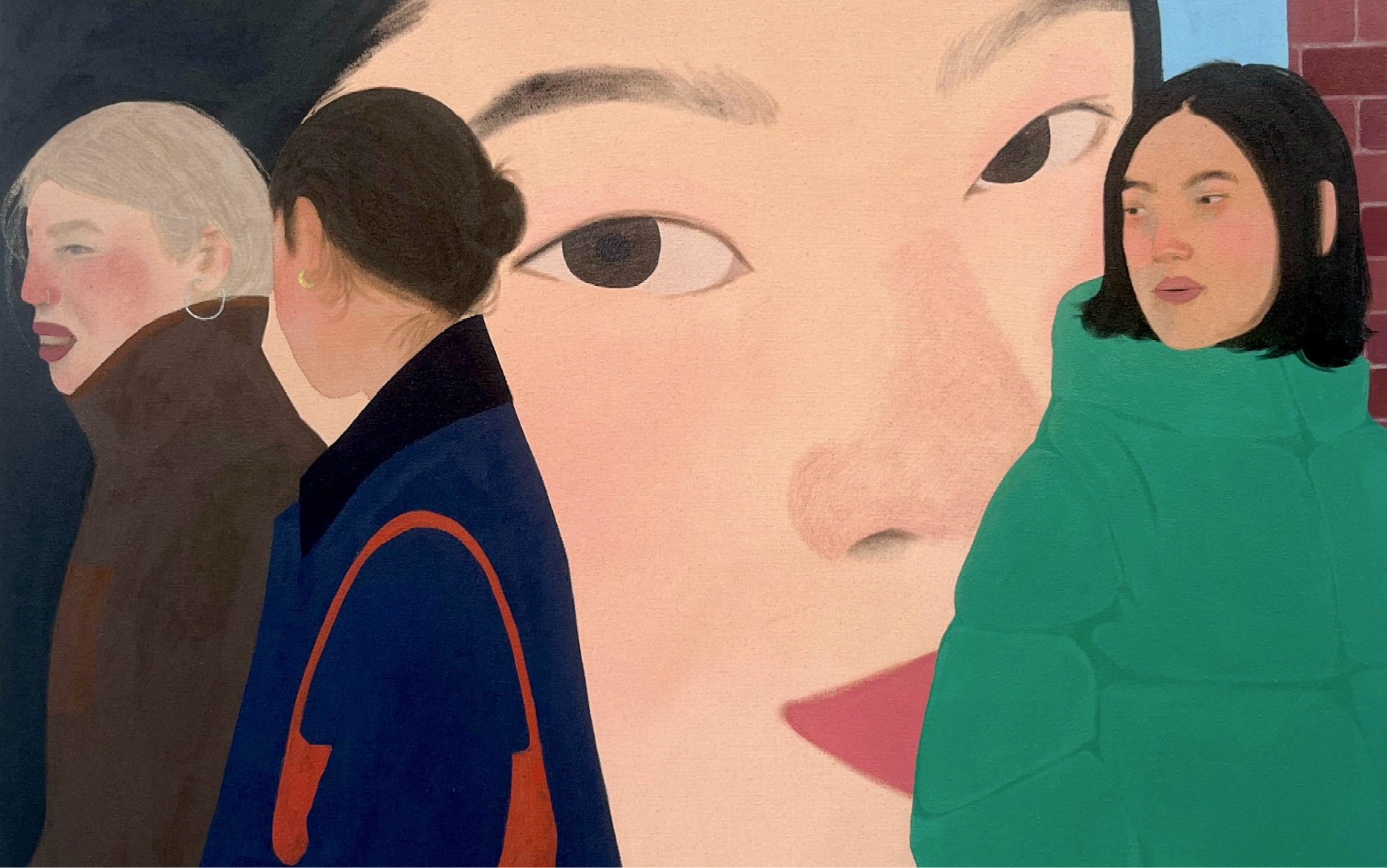
Just as looking and painting can imagine futures, they can also be employed to understand the present. Manila-born painter and graduate of the Rhode Island School of Design, Raya Simpao approaches painting as a relational practice—a means of understanding the world around her as a diasporic subject living in the United States. Her acrylic and pencil on canvas, Love You a Lot (2026), depicts a multitude of interconnections within a single social gathering. Like Renoir's Luncheon of the Boating Party (1881), Simpao's work contains a constellation of gazes, many of which remain unreciprocated. She observes others as they observe others, observing yet others in turn. These unrequited gazes do not register as absence or alienation; rather, each figure is rendered with tenderness and attentiveness. The anonymity of modern life is transformed into an opportunity for wonder, encounter, and care.
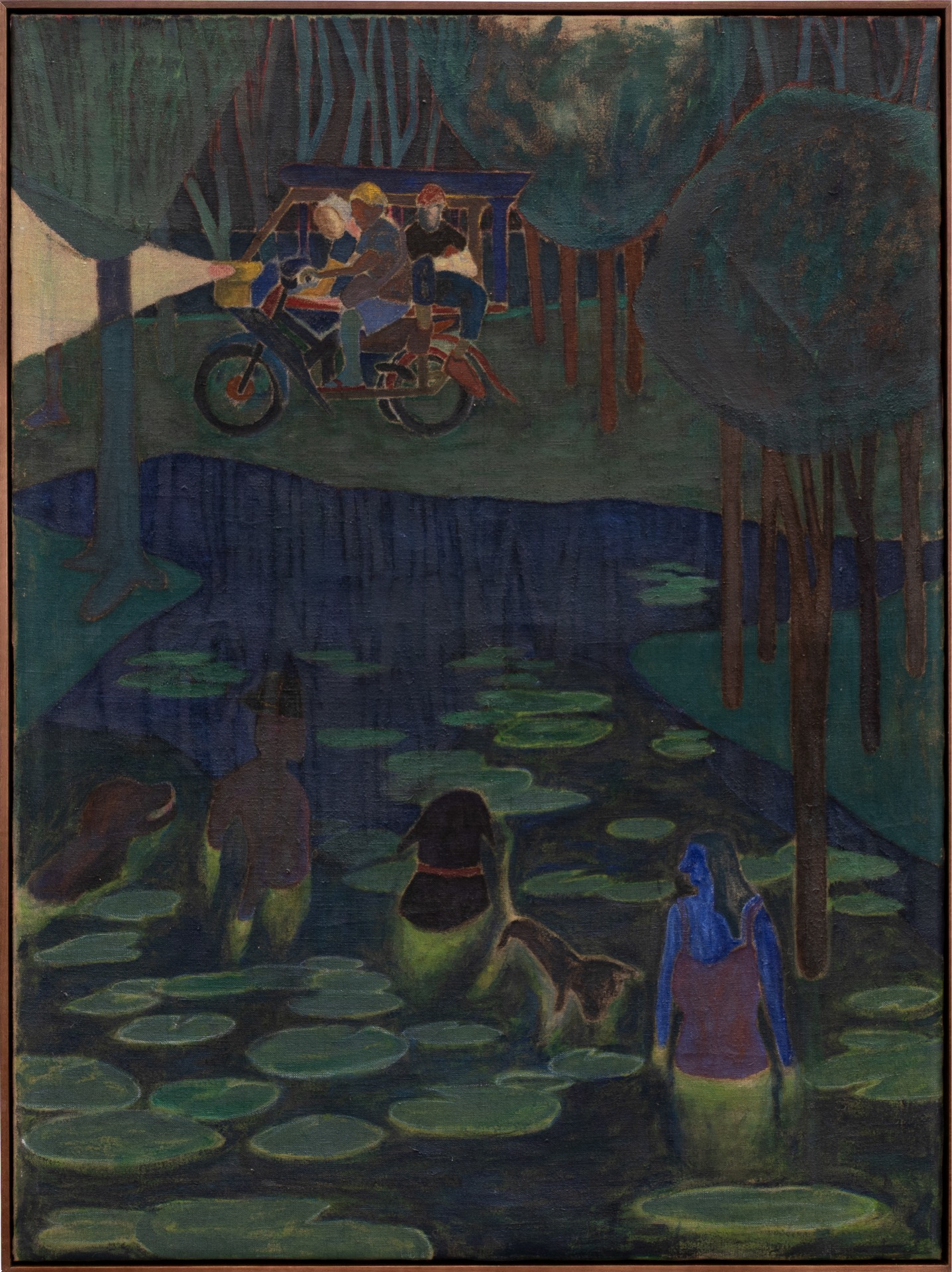
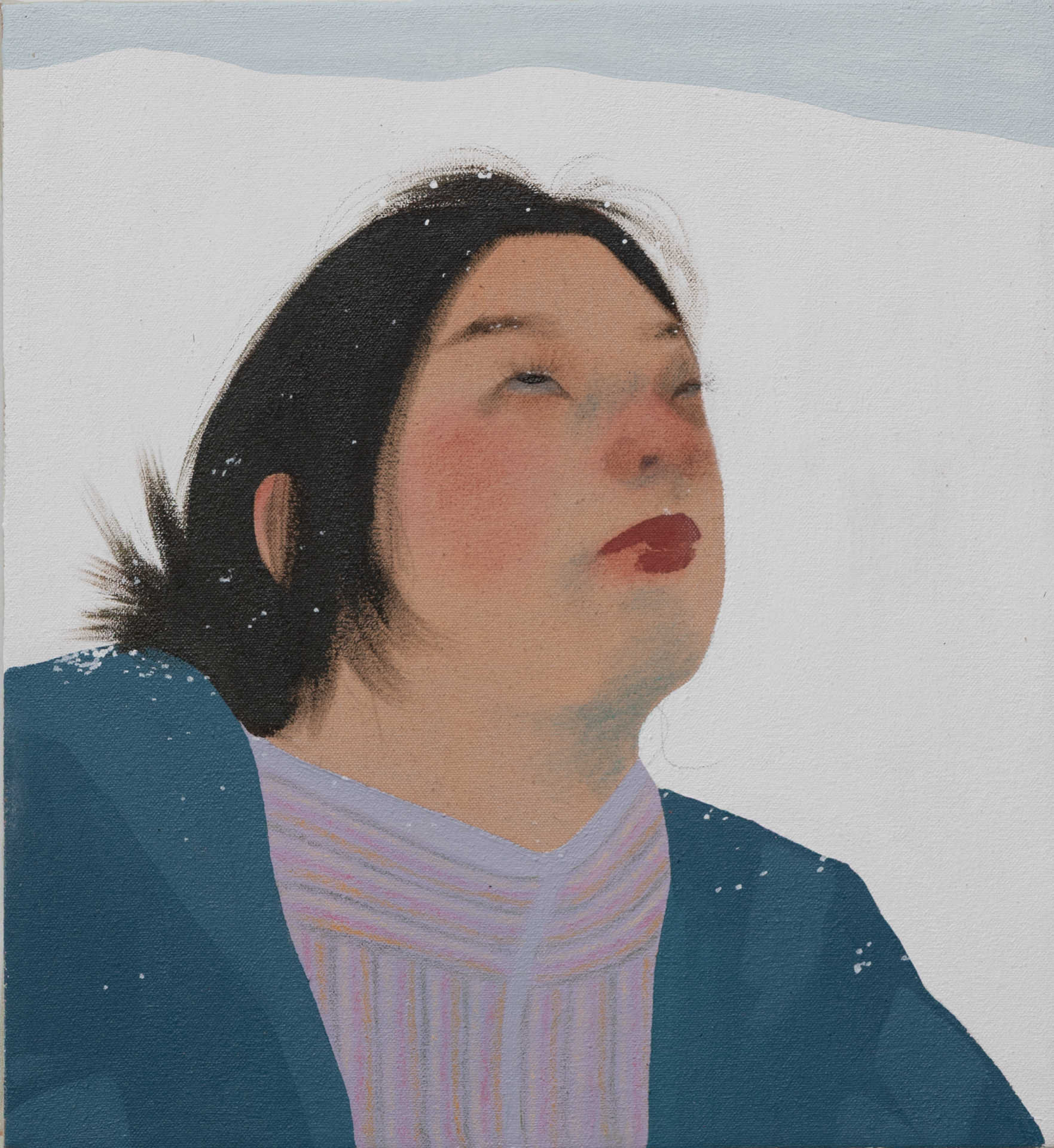
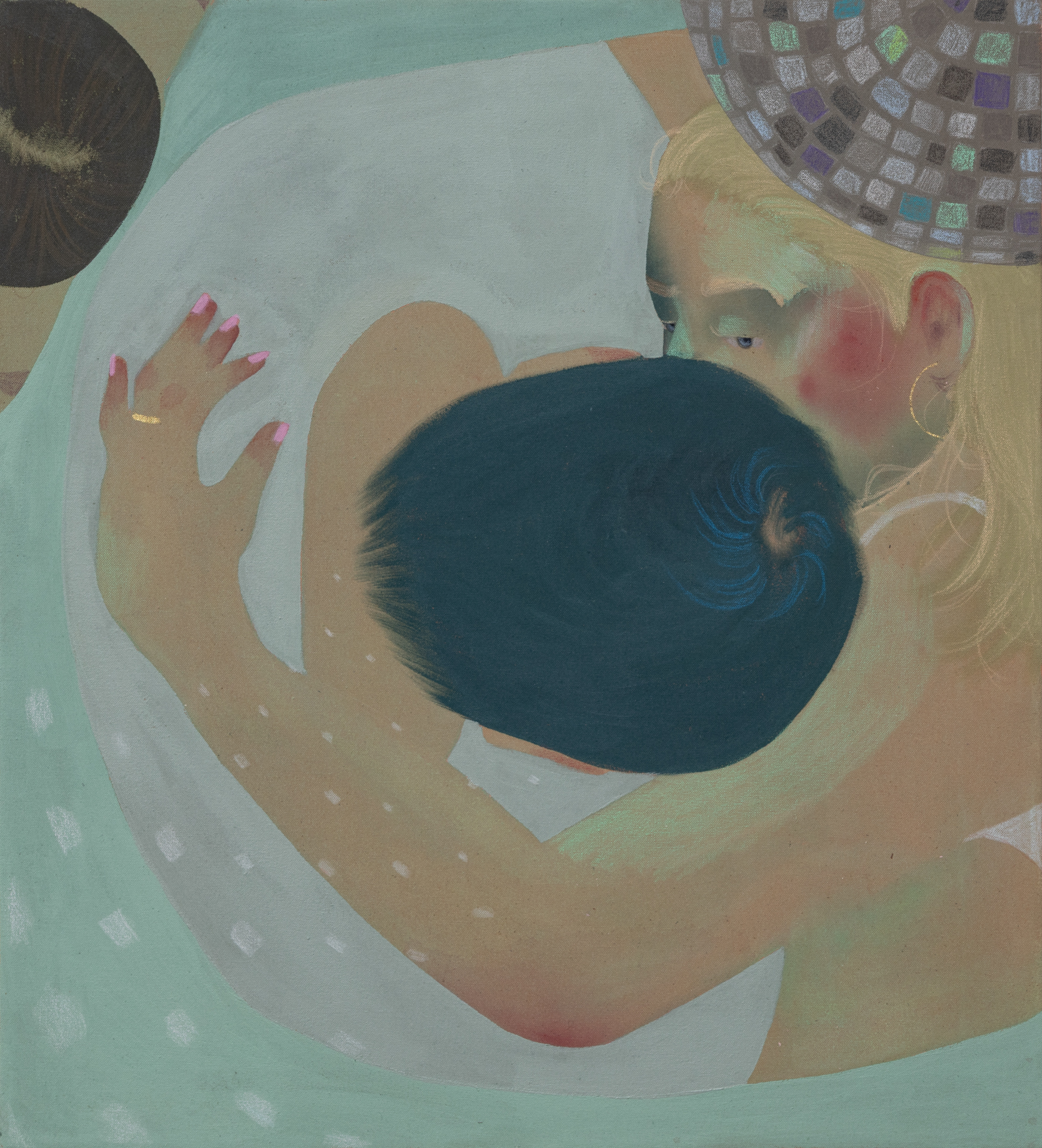
As a diasporic flâneuse, Simpao navigates unfamiliar social and cultural terrain, learning how to locate herself within a new context while remaining open to the astonishment of new experiences. In Heaven (2026), a Filipina woman gazes upward as the sky opens before her, experiencing what may be her first snowfall—a quintessential yet quietly magical moment for many who move from the Global South to the North. Simpao renders this everyday miracle with profound sensitivity. Snow becomes more than an unfamiliar climatic experience; it indexes discovery and the intimate process of inhabiting a new world. Through such moments, Simpao reminds us that belonging is not always found in grand narratives, but often in fleeting encounters that alter how we see ourselves and our surroundings.
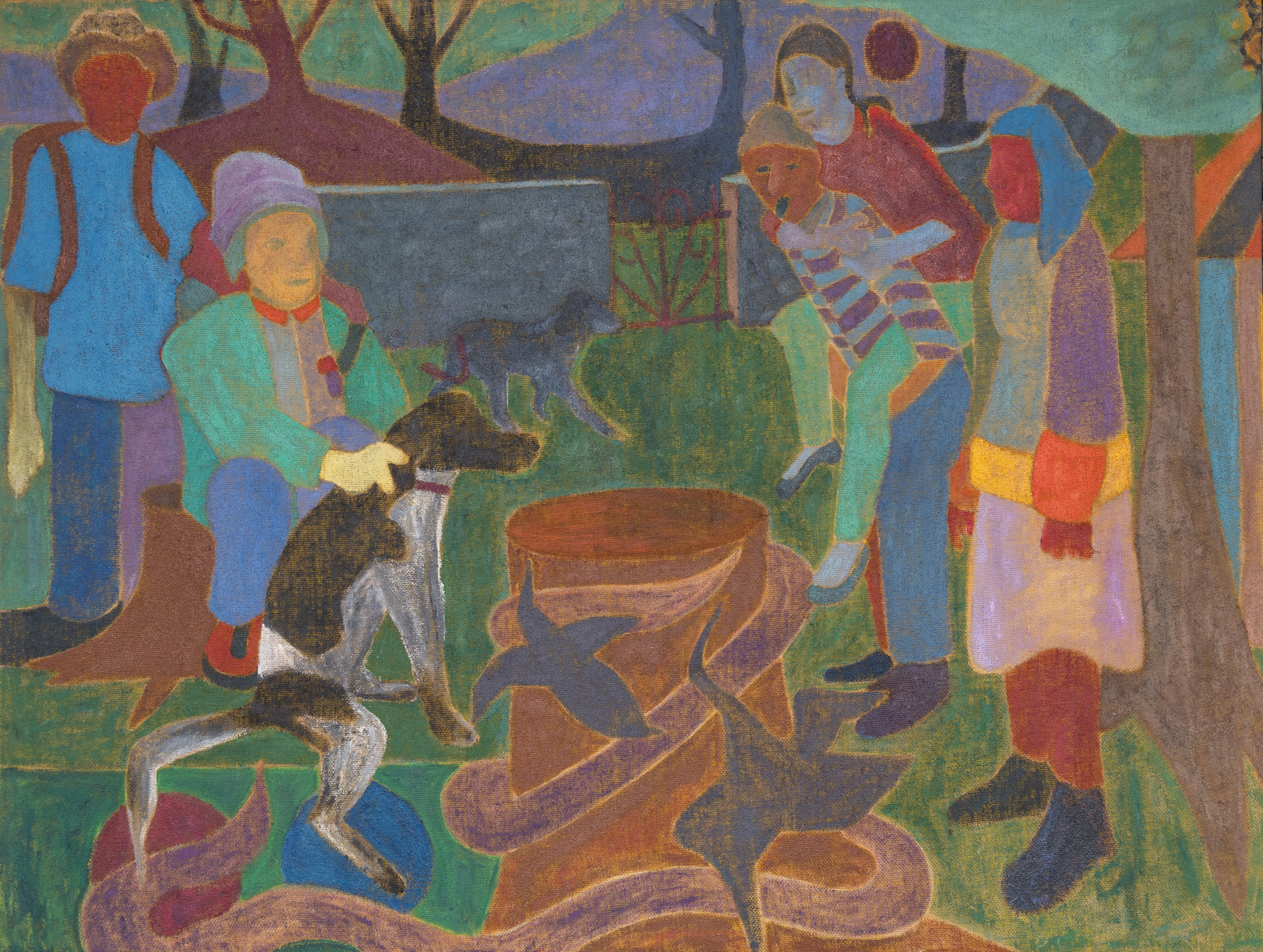
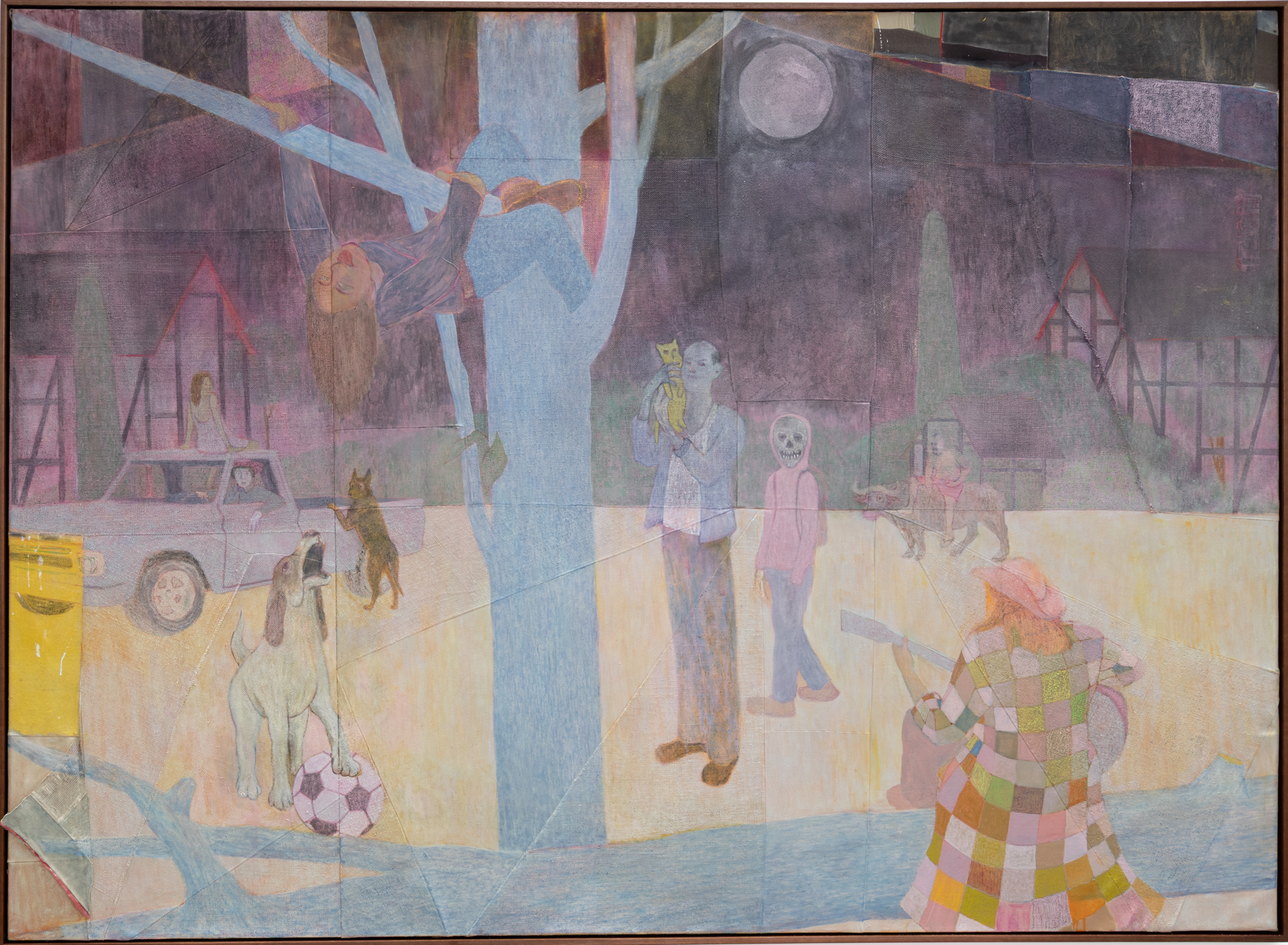
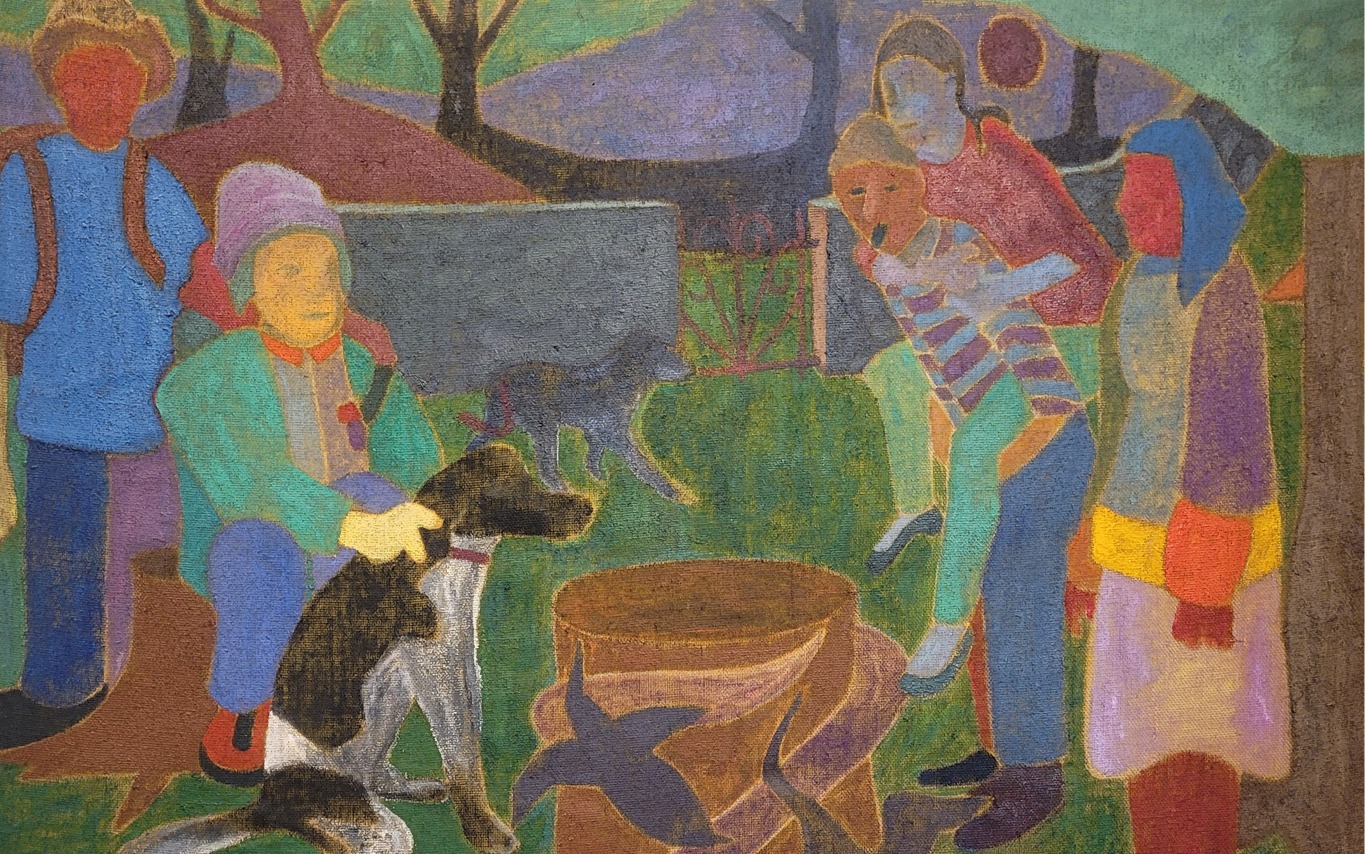
Danish Filipino artist Daniel Cabrillos Jacobsen draws inspiration from the celebrated Gee’s Bend quilts, created by generations of African American women in a secluded Alabama community. Jacobsen experiments with rectilinear and triangular fragments of fabric which are sutured together to form the painting’s support. This technique resonates with the Filipino ethos of diskarte—a form of ingenuity and resourcefulness born out of necessity. Yet the artist’s admiration extends beyond adaptive craftsmanship. The “necessity” here is about the need to construct a vocabulary for the interstitial nature of his diasporic identity. In Half Dream/Half Nightmare (2026), Jacobsen constructs an imagined space of collapsed geographies: a carabao walks in front of a traditional Danish house with wooden beams as a costumed American is set to trick-or-treat. A travelling musician, a stand-in for the artist himself, gazes upon this scene and ponders his place in it. Rendered with a muted palette, the resulting scene evokes a dream, suggesting a liminal space suspended between here and there, and among memory, presence, and destination.
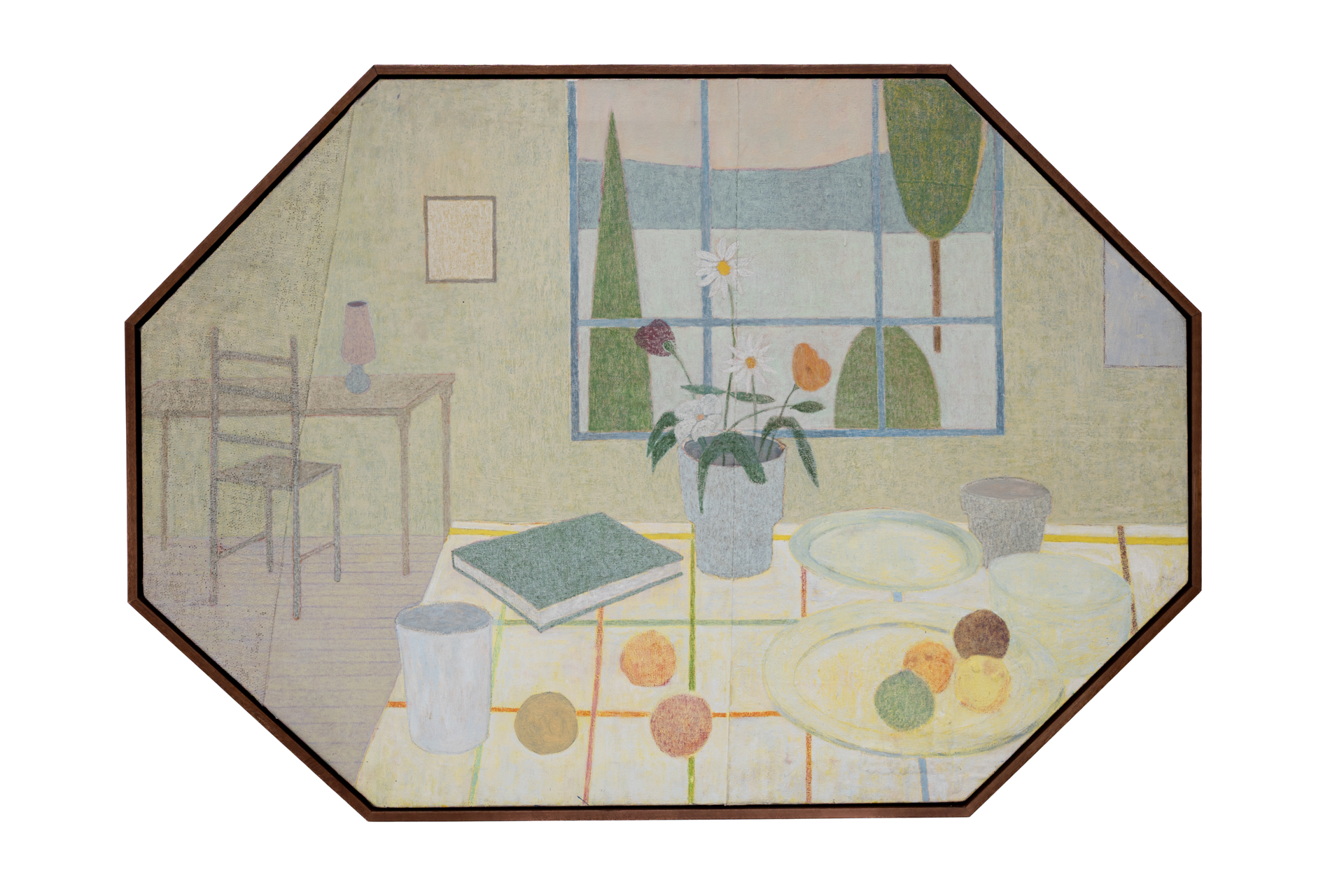
He recognizes in the Gee’s Bend quilts’ bold geometric compositions an affinity with the visual language of modernism, where abstraction emerges from everyday materials and lived experience. This influence surfaces in the Morning After (2026). The octagonal canvas functions as a window within a window, its layered framing emphasizing both looking, remembering, and yearning. The composition includes an empty chair at a desk, recalling the flattened perspective and quiet intimacy of Van Gogh’s Bedroom in Arles (1888). Devoid of a human figure, the scene nevertheless suggests the lingering traces of a small gathering the night before. Echoing Cézanne’s investigations of pictorial flatness, fruit rests upon a tabletop that is structured through a network of underlying grids—the stitched canvas, the checkered tablecloth, windowpanes, and architectural divisions of the interior. These compositional frameworks organize the space, while simultaneously drawing attention to its constructedness.
The seams, discontinuities, and subtle misalignments register a diasporic gaze—a mode of seeing shaped by migration, displacement, and desire for belonging. Through acts of stitching and repair, Jacobsen imagines forms of belonging that remain incomplete and emergent. Suspended between absence and possibility, his works thus become speculative spaces where disparate histories, geographies, and identities converge.
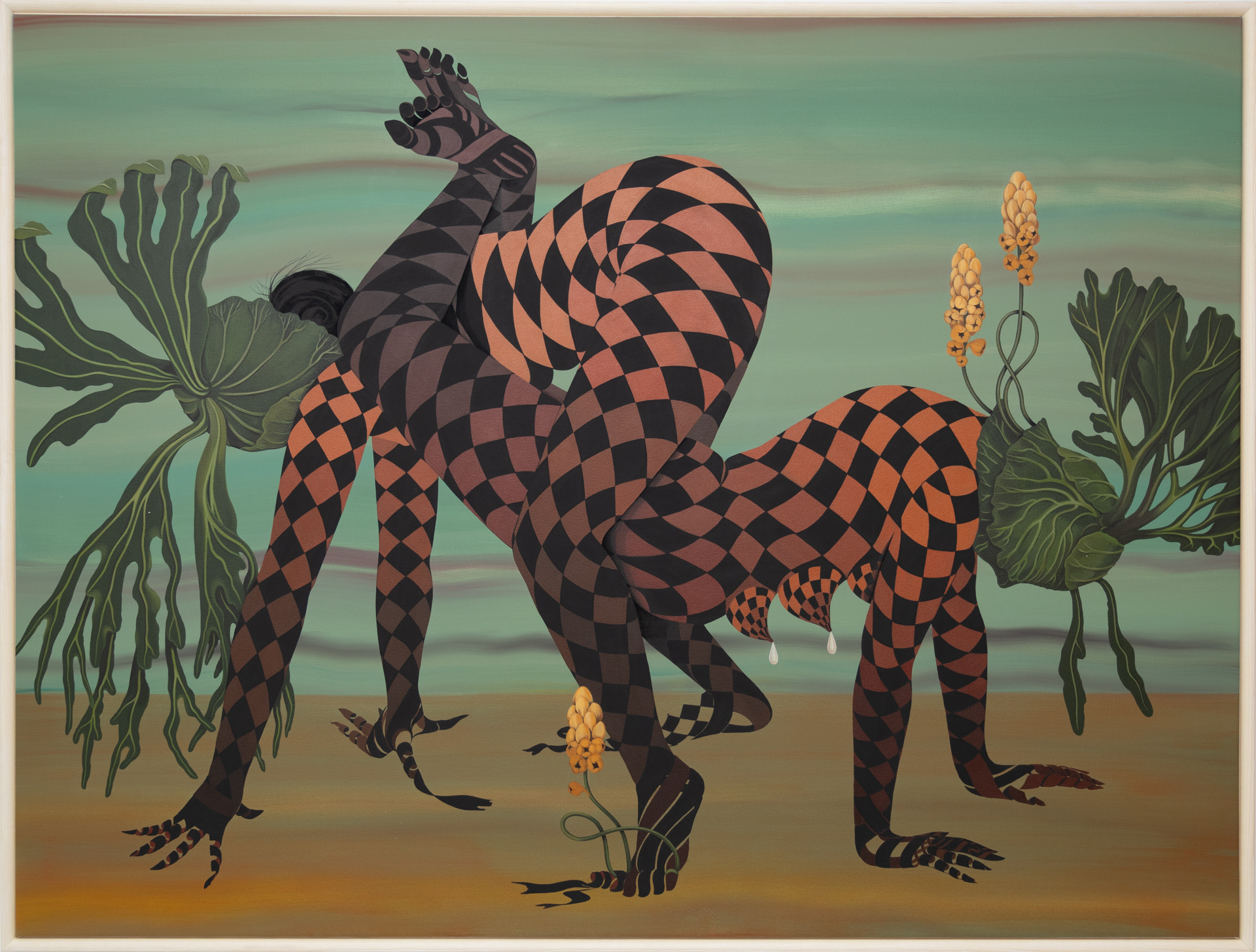
A diasporic gaze is shaped by global movements and by the ongoing effort to reconnect with histories, memories, and mythologies separated by oceans of time and conquest. This is evident in the work of Manila-born, Calgary-based artist Marigold Santos, who is best known for her reconfigurations of the aswang—the viscera-sucking figure of Philippine folklore—as an allegory for diasporic subjectivity. Currently exhibiting in In Minor Keys at the 61st Venice Biennale, Santos has garnered international attention for a practice that blends mythology, research on Philippine nature and culture, and her lived experience of as a diasporic Filipina. Together, these elements form a hybrid visual vocabulary that captures the multiplicity and fluidity of diasporic identity.
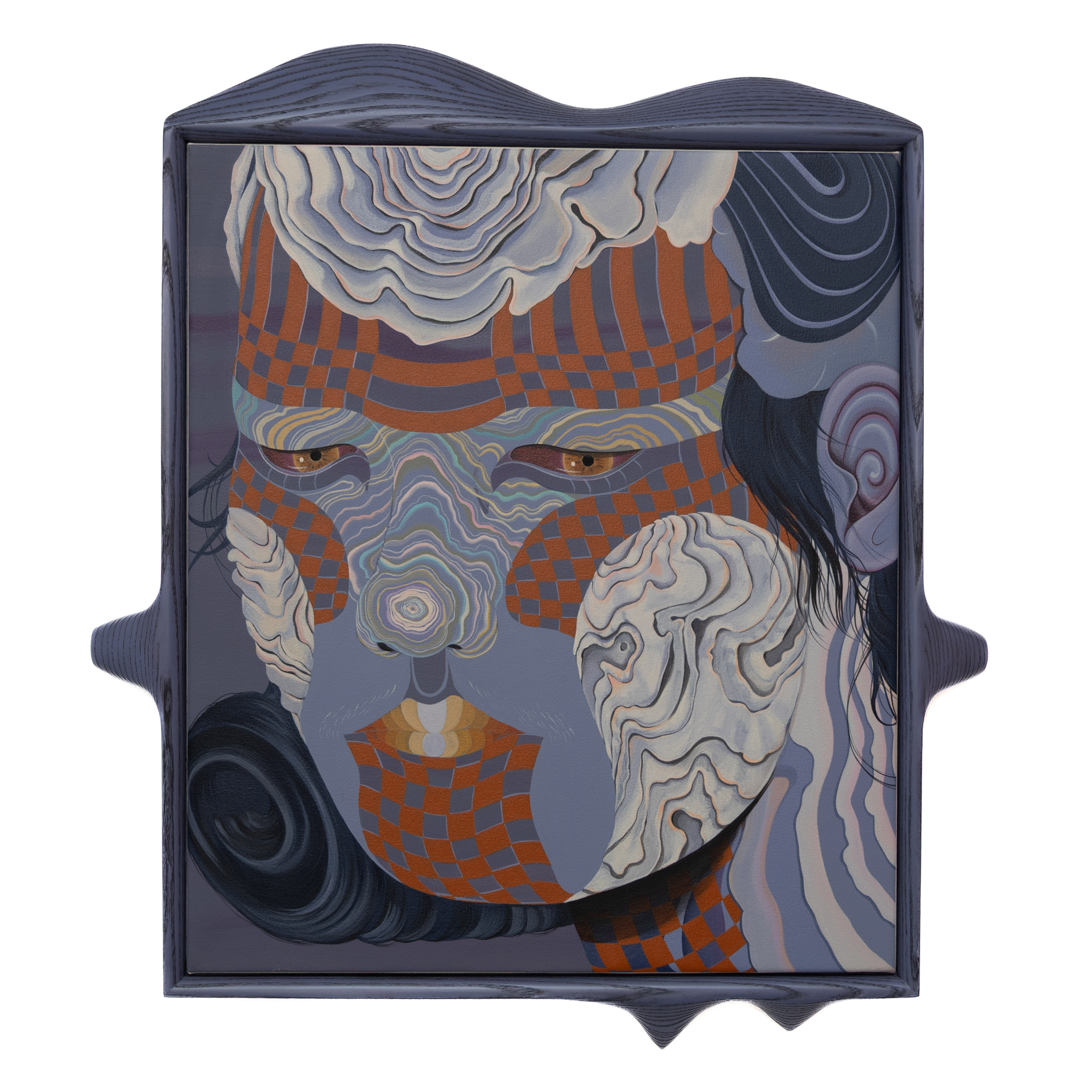
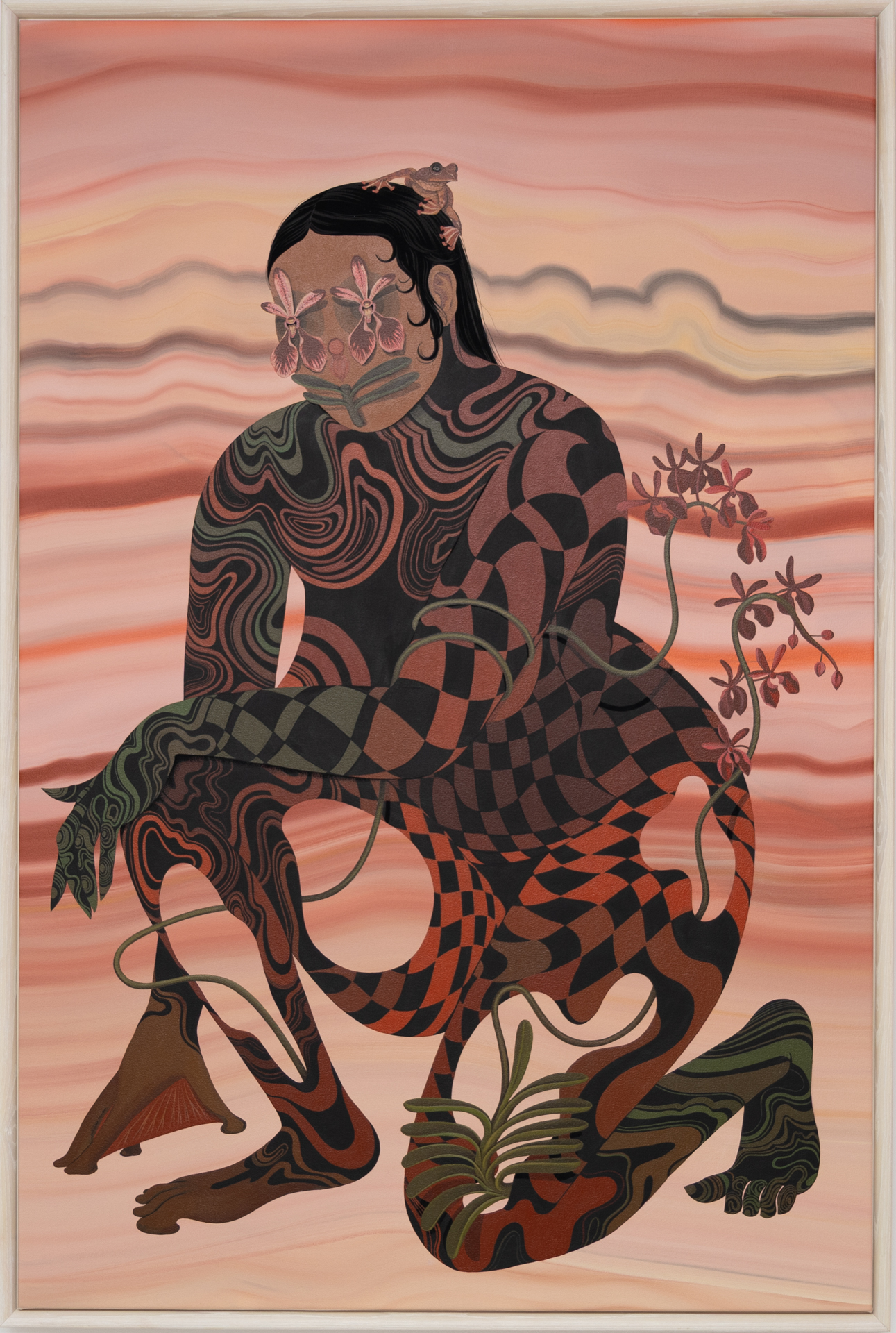
In this body of work, Santos turns her attention to epiphytes—organisms that grow in interdependent relationship with other living beings. For the artist, epiphytic plants serve as a metaphor for diasporic existence: just as they thrive through coexistence and mutual support, contemporary identities can remain connected to ancestral knowledge, labour, and cultural memory.
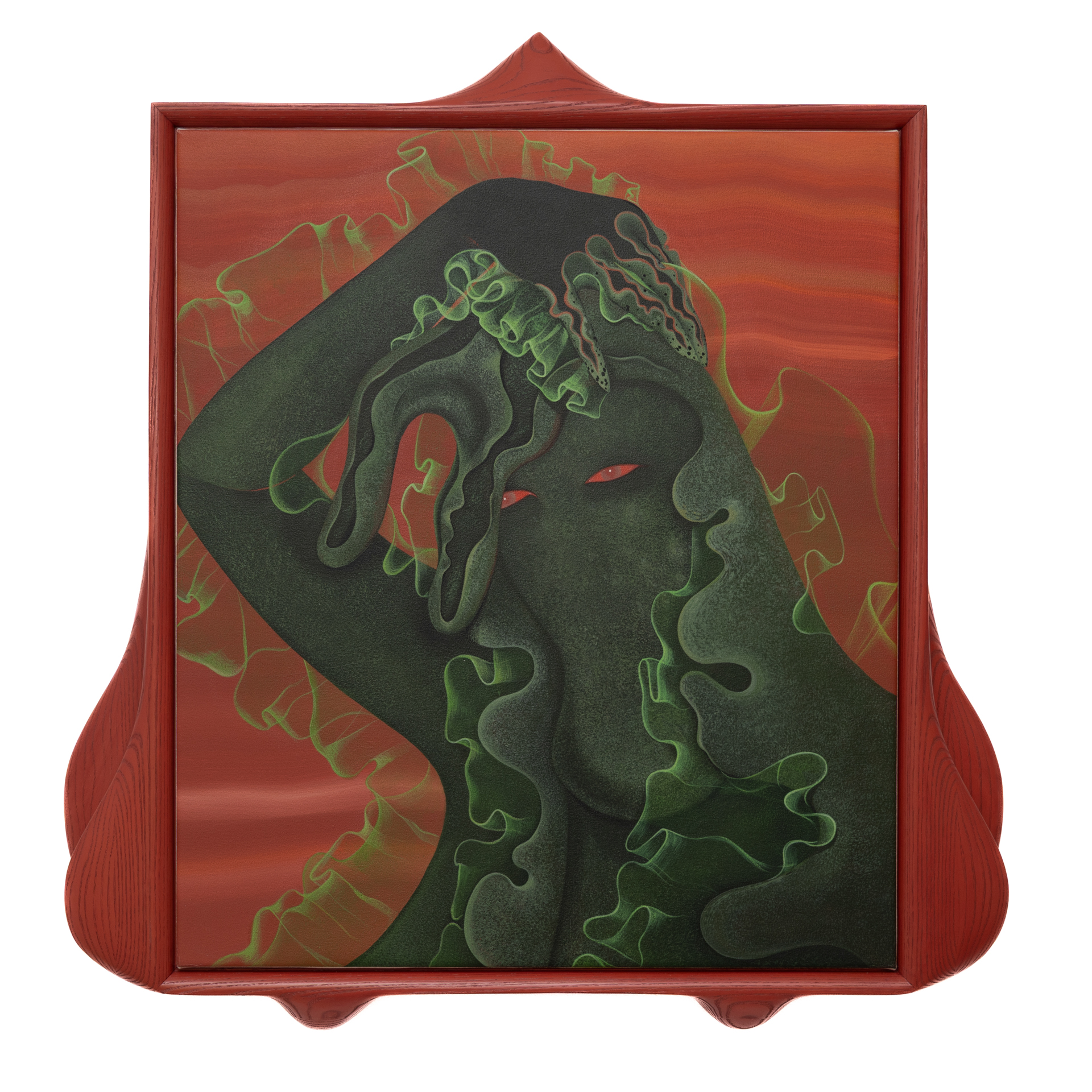
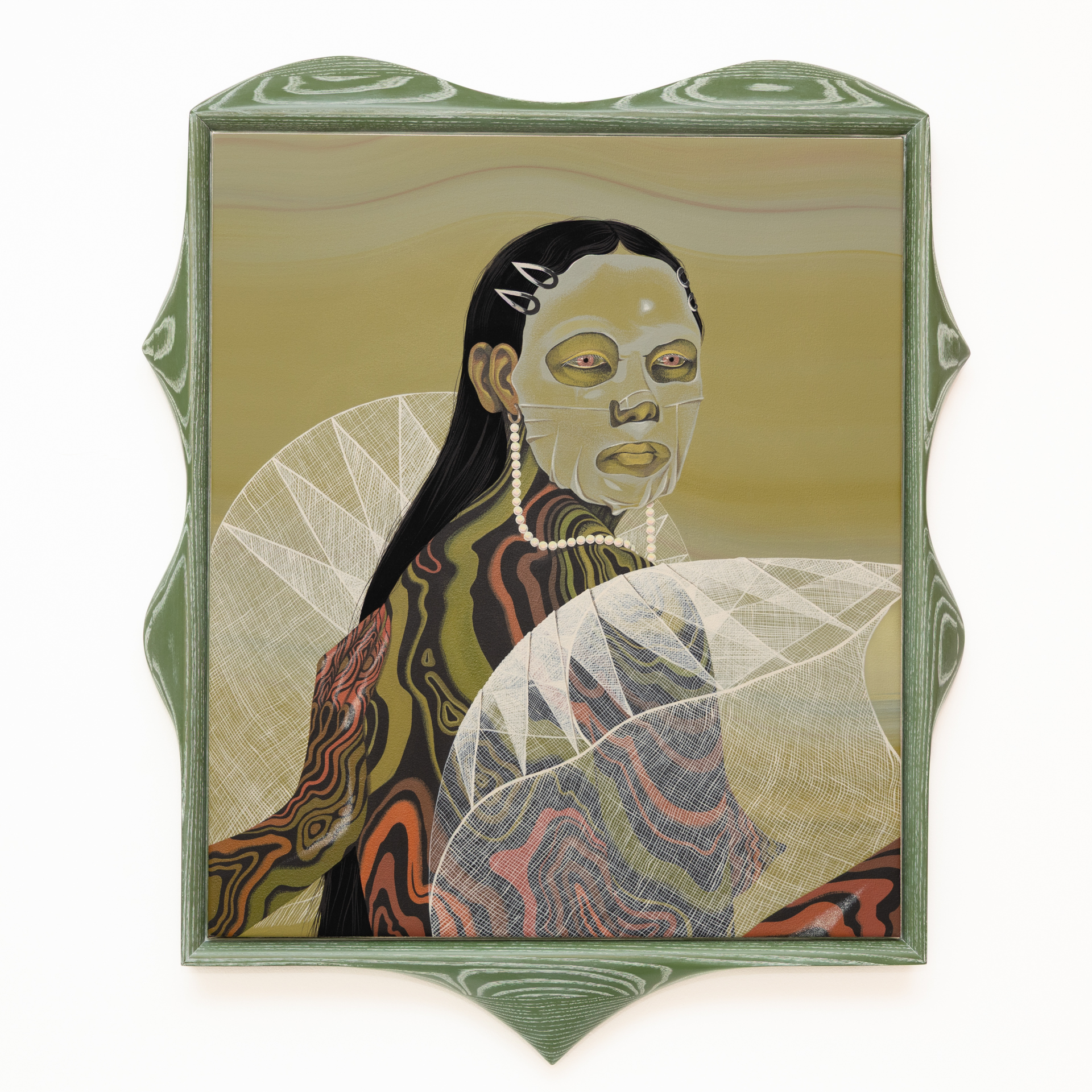
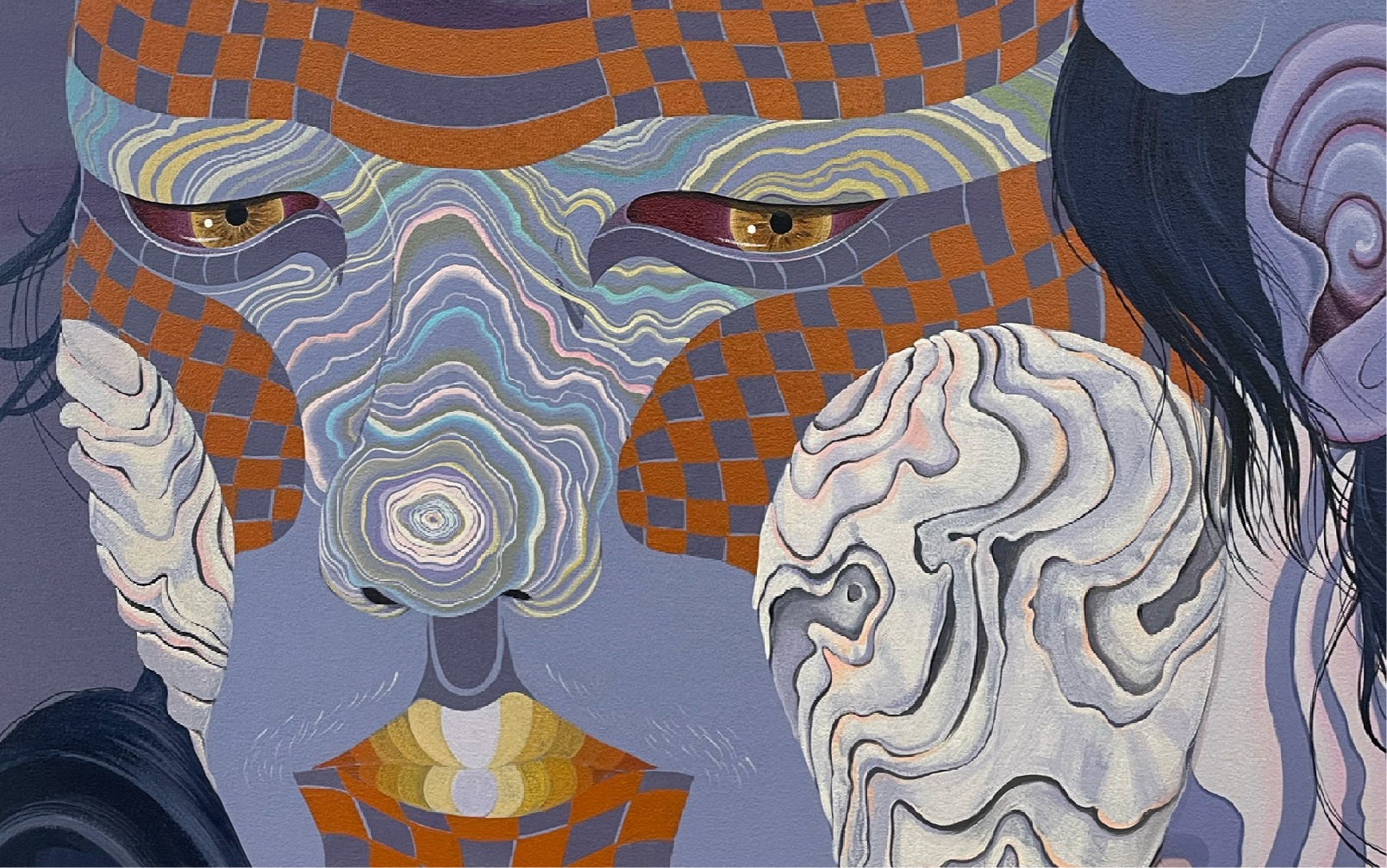
In sibling shroud (platycerium and candlebush) (2026), themes of labour and concealment emerge through masked harlequin-patterned aswang figures. The diamond motif recalls the banig weaving tradition, a craft historically associated with women's labour in the Philippines. The lactating breast of one figure is a maternal reference to nurturing life, which is Santos’s reclamation of the colonial vilification of the aswang. Here, weaving becomes both a formal device and a marker of inherited knowledge carried across generations. The siblings are intertwined into a human knot; a choreography of entangled bodies whose balance and movement rely on collective negotiation. Like diasporic identity, it demonstrates how connection, rather than autonomy, sustains the possibility of transformation.
In shroud sitter (Rhacophorus rizali and epiphytes) (2026), a tree frog identified by Philippine national hero José Rizal while in exile, crowns a woven aswang figure. Adorned with orchids indigenous to the Philippines, the figure embodies the persistence of cultural memory. Even in its apparent silence, it participates in the ongoing labour of carrying ancestral teachings forward. Porous and partially unravelled, the figure exists in a state of becoming rather than completion. Set against an agate-like ground that is at once terrestrial and celestial, the aswang inhabits a liminal space—an in-between realm that is no place and all places at once. Neither fully rooted nor entirely displaced, Santos' figures articulate a mode of belonging that emerges through relation, adaptation, and continual transformation.
The four artists in No Place approach diaspora through distinct visual and poetic languages. For each, painting functions not only as a medium but also as a form of mediumship—a conduit through which memories, histories, and imagined futures are summoned. Like ancient mariners, these artists sail the tides with their diasporic consciousness as their compass. Their works move beyond narratives of displacement to envision possibilities of harmony, collective care, and belonging, offering speculative glimpses of dreams yet to be realized.
Words by Dr. Marissa Largo
Marigold Santos (b. 1981, Manila, Philippines; lives and works Calgary City, Alberta, Canada) immigrated from the Philippines to Canada with her family in 1988. She pursues an inter-disciplinary art practice that gathers notions around heritage and cultural identity, folklore, motherwork, labour and decolonization, which integrate the natural world and are presented within the otherworldly. Her paintings, drawings, sculptures, and tattoo work emphasize self-hoods and identities that embraces multiplicity, fragmentation and empowerment as informed by diasporic experiences. She holds a BFA from the University of Calgary, and an MFA from Concordia University. She was long-listed for the prestigious Sobey Art Award in 2023 and 2024 and was recently awarded the inaugural ART SG Futures Prize at Art Singapore 2026. Efflorescence/The Way We Wake, a co-created work with Rajni Perera is currently on view at the 61st Venice Biennale, In Minor Keys, by Koyo Kouoh. She maintains an active studio practice and gratefully resides in Treaty 7 Territory, in Mohkinstsis/Calgary.
Raya Simpao (b. 2003, Manila, Philippines; lives and works in Brooklyn, NY, USA) grew up in Manila and moved to the United States, a dramatic shift in environment that sparked a deep curiosity about the possibilities of figurative painting. The foundation of her practice is a thoughtful, intentional seeing. For Simpao, painting begins with a sincere awareness of one’s surroundings. Her work serves as a record of time spent with a place, a person, or an idea. As she builds images, she draws from memories of the familiar as well as from encounters with the unfamiliar. Most formal decisions within the work such as shape, color, and light, explore the space between naturalistic and synthetic, often pushing the boundaries between the two. The paintings are often tonally ambiguous and spatially dynamic. We are introduced to each scene through a lens deliberately shaped by the artist's unique sensitivities, experiences, and instincts. At the heart of her practice is an ethic of care. Simpao considers the act of seeing– of looking closely, looking again, and looking with intention–as a form of labor that must be sustained by profound and persistent care.
Simpao received her BFA in Painting from the Rhode Island School of Design in 2026 and was an attendee of the Yale Norfolk School of Art in 2025. She was a recipient of the Florence Leif award and the 2026 Spring Innovate Grant. Simpao has been featured by a number of arts platforms such as Nicotine Magazine, The Hopper Prize, House House Magazine, and Booooooom.
Daniel Cabrillos Jacobsen (b. 1996, Copenhagen, Denmark; lives and works between Atlanta, GA, US and Copenhagen) is a Danish–Filipino artist, born and raised in Copenhagen, Denmark. He earned a BFA from the Royal Academy of Art in The Hague in 2023. In 2024, he was nominated for the Royal Award for Modern Painting at the Royal Palace Amsterdam—one of the Netherlands’ most prestigious prizes for emerging painters. He is currently based in Atlanta, pursuing an MFA at the Ernest G. Welch School of Art & Design at Georgia State University.
Deeply influenced by his mother’s migration from the Philippines to Denmark at the age of 30, Cabrillos Jacobsen’s practice is rooted in painting and reflects a sustained inquiry into cultural contrast, identity, and belonging. He uses the medium as a tool for storytelling, reflection, and self-exploration. His paintings often navigate memory and identity with a rhythm that blends playfulness and melancholy. Cabrillos Jacobsen builds his compositions through layered applications of paint—scraping, revising, repainting—allowing time and remembrance to take form through surface and texture. These layered, tactile works become quiet, contemplative spaces: personal responses to the complexities of the present. A sense of in-betweenness lies at the heart of Cabrillos Jacobsen’s work: interior and exterior, presence and absence, the seen and the felt. His paintings often weave together fragmented narratives drawn from personal history, cultural memory, and the spaces that connect them
iris yirei hu (b. 1991, Los Angeles, CA, USA; lives and works in Los Angeles) is a multidisciplinary journey-based artist working across painting, installation, intercultural collaboration, writing, and public art. Her work is rooted in material and spiritual transformation, probing grief, cycles of life and death, and the self as it evolves and relates across cultures, generations, and geographies. In 2022, LA Metro commissioned her to design what will be the largest mosaic by a single artist in the region’s transit system at the future D Line Westwood/UCLA station. Her work has been exhibited at venues including the Institute of Contemporary Art, Los Angeles; The Armory Show; Center for Arts, Research, and Alliances; Museum of Contemporary Art Tucson; Plug In ICA; and John Michael Kohler Arts Center. Her honors include: Ruffin Distinguished Artist-in-Residence at the University of Virginia (2026), Longenecker-Roth Artist-in-Residence at UC San Diego (2025), Kohler Arts/Industry Residency in Pottery (2025), California Community Foundation Fellowship for Visual Artists (2022), California Arts Council Individual Artist Fellowship (2021), and the Foundation for Contemporary Arts (2018, 2020). Her writing has appeared in Amerasia Journal and her work has been reviewed in the Los Angeles Times, Artforum, CARLA, and Hyperallergic, among others.
Works